Some home shoppers decide whether or not to buy a property based on their ability to pay the mortgage and utilities. Obviously, it’s critical to budget for direct housing costs. But, neglecting to budget for ongoing home maintenance and repairs can wreak havoc on your finances.
Truth be told, unexpected house repairs are one of the most stressful things any homeowner can experience. If you add in the surprising cost creep of even standard home maintenance tasks, your annual budget could be hundreds or even thousands in the red by the end of the year.
While you can’t avoid the necessity of home maintenance, or the costs associated with these tasks, you can avoid the financial surprises by planning ahead.
What is Home Maintenance?
Regular maintenance is necessary to keep the property in good shape and to prevent significant problems from developing. It is critical to prepare ahead and set aside money so that you are not caught off guard financially.
While home maintenance can include a variety of tasks, a few of the more common maintenance jobs include:
- Cleaning and repairing windows and frames;
- Replacing furnace filters and air filters and checking your HVAC system;
- Examining your home’s roof and attic to determine if repairs or replacements are needed;
- Examining the home’s internal foundation, looking for water damage or cracks in walls;
- Confirming there are no leaks in your plumbing system and checking to make sure sump pumps or floor drains are working and not clogged;
- Repairing any electrical system damage;
- Cleaning and maintaining chimneys or fireplaces;
- …among other tasks.
For many homeowners, the maintenance task list can be off-putting. Keep in mind that all homes, regardless of their age, will require maintenance. While maintenance costs tend to increase as homes get older, that doesn’t mean newer homes or even new builds, won’t require time and money. You need to set these two things aside for monthly, seasonal and annual maintenance and upkeep.
How Much Does House Maintenance Cost?

Truth be told, it’s impossible to predict exactly what maintenance your home will need, how much it will cost and when it is necessary. But, you can use data and a bit of knowledge to increase your odds.
In my new book, House Poor No More, I go into quite a bit of detail on how to budget for home maintenance and how to plan and prepare for strategic updates.
In a nutshell, home maintenance captures all the ongoing tasks you should repeat to keep a home working optimally. Likewise, it does not factor in the upgrades required to keep your home operating at its highest and best use. Examples of strategic updates include:
- a new furnace or air conditioner
- replacing the roof
- replacing windows and doors
- new paint (inside and out).
These tasks wouldn’t be completed on an annual basis, but neglecting the need to monitor and upgrade, when appropriate, can seriously hurt your home’s integrity and overall market value.
The bottom line is that each year Canadian homeowners pay, on average, between:
- $1,230 to $7,070 on annual home maintenance, and
- $3,526 and $11,166, on strategic (amortized*) updates.
(*To appreciate how I calculate the amortized costs, please see Chapter 3 of House Poor No More.)
The low end reflects the costs of very well-maintained homes with all of the work completed by a handy homeowner; the top end reflects a completely hands-off, pay-someone-to-do-just-about-everything homeowner living in an older or seriously neglected home.
The cost of total annual home maintenance sounds expensive, right? It should be! Because homeownership is expensive. The good news is the more proactive you are about completing ongoing annual home maintenance tasks, the fewer the surprises and the less you end up paying, overall.
Home Repairs and Maintenance: Where to Start?

It can be hard to stay on top of simple house maintenance tasks. However, things like changing your furnace filter, making time to vacuum refrigerator coils or clean the gutters, or replacing smoke detector batteries are key. It helps to follow a home maintenance checklist. But there are so many out there, how do I know which one to use?
My preference is to list the tasks based on the seven vital components of your home—external structure, roof, landscaping and grading, foundation, HVAC, electrical and plumbing. From there, break this list down into task lists by season.
Why do it this way? Because each of the seven components is critical to maintaining the integrity and the value of your home. Neglect one area and you run the risk of unexpected and potentially expensive repairs (or worse, devaluing your property).
Another basic reason for a task list by season is that it keeps the overall checklist manageable and logical. You wouldn’t wash your siding or windows in the winter if you lived in Northern Ontario—even if you could get water to flow through the hose in the first place!
Ultimate Home Maintenance Schedule
The overall idea when using an annual maintenance schedule or checklist is to create a systematized process. This ensures all tasks get done and nothing gets overlooked.
To help with your Spring, Summer, Fall, and Winter maintenance tasks, here is a checklist to get you started. Included in this home maintenance checklist are critical tasks, estimated timelines, and the costs associated with doing the work yourself or paying a professional to get it done.
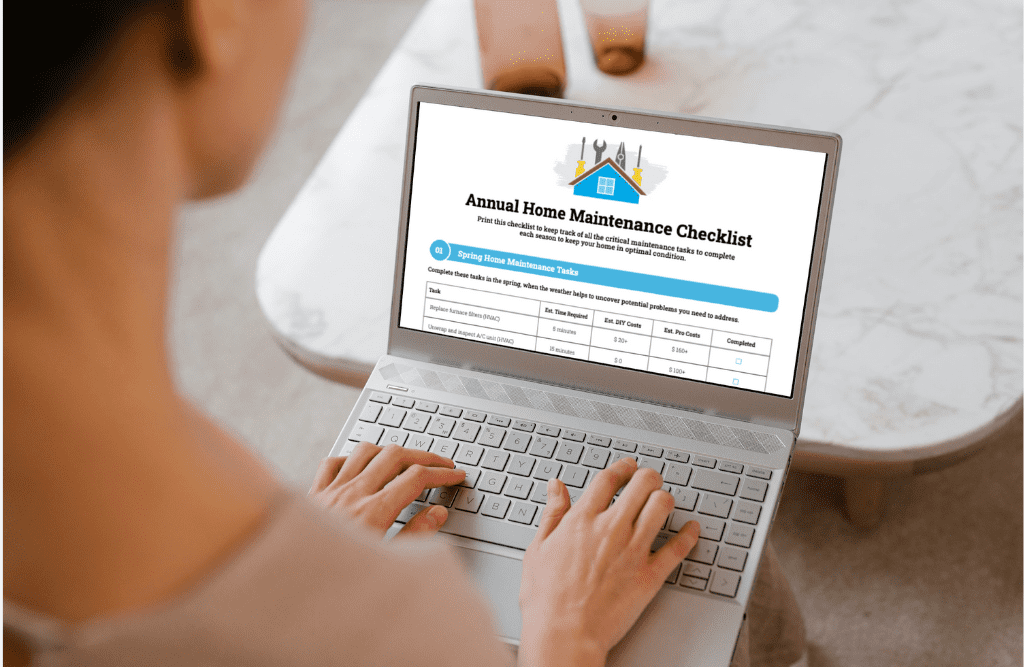
10 Vital Home Maintenance Tasks You’ll Regret If You Forget
Even with all the checklists on the market, it can be easy to neglect some home upkeep tasks. So, to help you remember, here are 10 of the most critical tasks to accomplish, and why.
- Replace Furnace Filters
To prolong the life of this expensive home appliance, and maintain clean, healthy airflow, be sure to remove old furnace filters. You should replace them with new filters at least once every three months. - Fill Foundation Cracks and Holes
Cracks and holes around your home are fairly common, given how much homes shift and settle over the years. However, to prevent potential water damage or vermin infestation, be sure to patch and repair small cracks and holes. - Test the Sump Pump
If your home uses a sump pit or sump pump, be sure to check water levels and confirm that the pump is working. Skip this task and you run the risk of a messy flood. - Clean Appliance Grills, Filters, and Coils
At least once per year vacuum your refrigerator’s coils, wash your range hood filters and clean the grills or filters in your major appliances. Skip this and your appliances will have to work much harder to do their job. This will leave you with expensive repair bills. - Drain Sediment from Hot Water Tank and Check Pressure
Want to avoid replacing this expensive home appliance sooner than expected, then be sure to drain some of the water, each year. These tanks work by using a metal rod to attract corrosive elements so your tank doesn’t rust. Over time there’s a build of sediment. If not removed this gunk can block and clog your hot water tank (causing damage or destroying the tank’s function). - Clean Your Gutters
Want to avoid overland flooding or water pouring through window wells or down the foundation? Clean your gutters. Gunk in the gutters clogs up this channel, which is critical for moving water away from your home. - Check for Vermin and Insect Infestation
No one likes an unwelcome guest, particularly rodents or insects. While it’s not fun, be sure to check for evidence of rodents and insects. If you find evidence, deal with the problem immediately. Home insurance doesn’t cover damage from these pests—and time rarely makes this problem go away. - Clean Dryer Vents
At least once per year, go outside and clean out the dryer vent. Skip this task and you will end up using more energy to dry your clothes and possibly start a house fire. - Clean Bathroom Exhaust Fans
Like many other filters in the home, the bathroom exhaust fans are critical for removing moisture and debris from the air. Over time they get clogged. At least twice a year, be sure to clean the exhaust fans. This removes debris, helps your fan work more efficiently, and keeps the air cleaner. - Inspect Trees and Tree Limbs Near the Home
Depending on the proximity to your home and the tree’s condition, be sure to inspect any tree that could damage your home, should it fall. Windstorms and powerful winter storms can wreak havoc on tree limbs. But judicious annual pruning can usually remove any danger spots (and avoid expensive home repairs).
Tips to Help Afford Home Maintenance Costs
If you haven’t already, you need to start including home maintenance as part of your monthly and annual budgets. Even with a budget and a well-researched understanding of housing costs, home upkeep can be pricey. So, to help, here are three tips to help you plan and pay for home maintenance costs.
Save More Into Your Emergency Fund
A great way to build a buffer—and protect your budget and financial goals—is to pump up the amount you save in your emergency fund. This doesn’t mean you should ignore other needs or wants, but even an extra $100 per month can go a long way to minimizing the impact of unexpected housing repair expenses.
To protect your money, be sure to keep it accessible and not in a fund that rises and falls with the market (like a stock or ETF). A good option is a high-yield savings account.
Plan Renovations and Repairs Around Cost Savings
Repairs and upgrades are part of homeownership but you can use these expected costs to plan upgrades that help you save money. For instance, if you’re still relying on a mid-efficiency furnace, start saving for a high-efficiency model and shop around for discounts, sales, and rebates. Most cities in Canada now offer rebates on home upgrades. These changes can minimize the use of non-renewable resources. So, take advantage of these incentives. The upgrade will cost you, but you’ll get money back on the rebate and save money on your future utility costs.
Get a Home Warranty
While not as popular in Canada, there are some developers and some jurisdictions that offer Homeowner’s Warranties. While you pay for this insurance—either yearly or annually—it can help defray the costs. Particularly for more costly repairs, such as issues with your electricity, plumbing, or HVAC system. Just be sure you really read and understand the terms of your contract. There are always conditions that must be met.
Maintenance and Home Repair Services
There is one final option: consider hiring a person or company to complete the home maintenance or home repair tasks for you.
This isn’t a cheap option, but it can certainly be worth the cost if you find yourself unable to schedule the time for ongoing home upkeep.
If you opt to pay professionals be sure to adjust the home maintenance costs in your budget. Based on my analysis, homeowners who pay professionals to complete these tasks need to budget between $7,000 and $12,000 per year in maintenance and repair costs. That’s about $585 to $1,000 per month. Of course, the condition of your home, the property’s size, and age, among other factors will certainly influence your overall cost.
Bottom Line
Remember, big isn’t necessarily better, especially when it comes to heating and cooling. A nice home perched on a gorgeous hill may be a dream come true. But shovelling that long, sloped driveway in the winter could be an expensive nightmare. That 3,000-square-foot fixer-upper could be a steal until you discover you’ll have to renovate every room, upgrade all the plumbing, replace the roof, and re-do all the electrical.
For first-time homebuyers, be sure to examine the property’s condition and factor in the size of the home and the size of the lot. Only take on a property you truly feel capable of taking care of. Consider both your busy schedule and your monthly budget. In the end, the best defence against overwhelming home maintenance costs is to select and purchase a property you can manage. And remember your reasons for buying a home.
Quite often, we wanted the safety and security of having our own place; a safe haven where we could rest, relax, be with family and enjoy some downtime. For that reason, the good news is that all the effort you put into maintaining your home helps this asset to retain (and even increase) its value. While your home shouldn’t be considered an investment, it is an asset—a valuable asset that needs to be taken care of.